
Keen Kutter: The History Behind the Mark
From a St. Louis hardware empire to the old roofing hatchet that helped start Moab Maverick Tools: the documented history, surviving evidence, and enduring legend behind Keen Kutter.
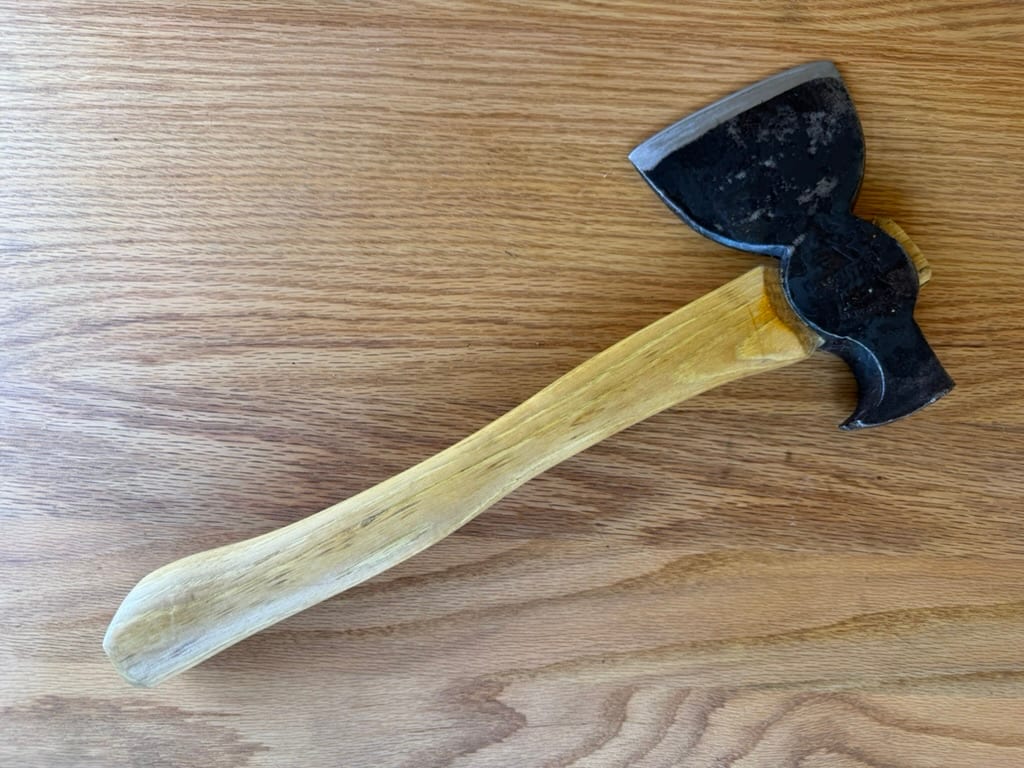
The first vintage tool I restored for myself was an E.C. Simmons Keen Kutter roofing hatchet.
I wasn't trying to start a vintage-tool business. I needed a hatchet. A good modern one wasn't particularly cheap, and I had already developed an appreciation for older American tools. When I came across the Keen Kutter, its St. Louis connection was part of what made me choose that particular tool. I had lived in St. Louis for 26 years, and E.C. Simmons and Keen Kutter were part of that city's enormous hardware history.
The hatchet had originally been made for roofing work, but there was no reason a properly cleaned, rehung, and sharpened example couldn't serve as a general-purpose camp and utility hatchet. I restored it, made a sheath for it, and put it back to work. It still rides in my truck.
Somewhere in that project was another realization: I enjoyed doing this enough that perhaps restoring other old tools could become a hobby that paid for itself. That idea eventually became Moab Maverick Tools.
So Keen Kutter occupies an unusual place here. I didn't become interested in Keen Kutter because I started MMT.
In a small but very real way, MMT exists because I became interested in Keen Kutter.
The Hardware House Behind the Mark
Keen Kutter was not originally a manufacturing company. It was a trademark belonging to the Simmons hardware business of St. Louis, and that distinction becomes important when identifying old tools.
Simmons was a major hardware jobber: a wholesaler that bought enormous quantities of merchandise and distributed it through hardware dealers. A 1936 federal appellate decision described Simmons Hardware Company as “a hardware jobber, selling a great variety of tools and implements.” Keen Kutter became one of the company's great proprietary identities, eventually appearing on an extraordinary range of tools and other merchandise. The 1916 federal trademark registration alone covers an enormous catalog of hand tools and implements.
We don't have to rely entirely on catalogs or later histories to understand how that worked. Saunders Norvell, who joined Simmons as a young man and eventually became its sales manager, wrote about the business from firsthand experience in his 1924 memoir, Forty Years of Hardware.
One of his stories concerns Keen Kutter sheep shears sold in Colorado and New Mexico. Simmons bought the shears from the English manufacturer Burgon & Ball, which etched a picture of a man shearing a sheep onto one blade and Keen Kutter onto the other. Norvell describes merchants trying to explain that Burgon & Ball actually made the shears and Keen Kutter was simply Simmons's special brand. The customers weren't interested in that distinction. They recognized the picture and wanted the Keen Kutter shears.
Later, Norvell says, the J. Barton Smith Company of Philadelphia manufactured Keen Kutter sheep shears for Simmons for many years. A 1936 federal appellate decision provides another example, recording Christy Company's manufacture of razors and blades sold by Simmons under the Keen Kutter trademark.
That gives us a particularly clean example of what a Keen Kutter mark does—and does not—tell us. It identifies the product with Simmons and its Keen Kutter brand. It does not necessarily identify the factory that physically manufactured it.
The mark is evidence. It isn't the entire answer.
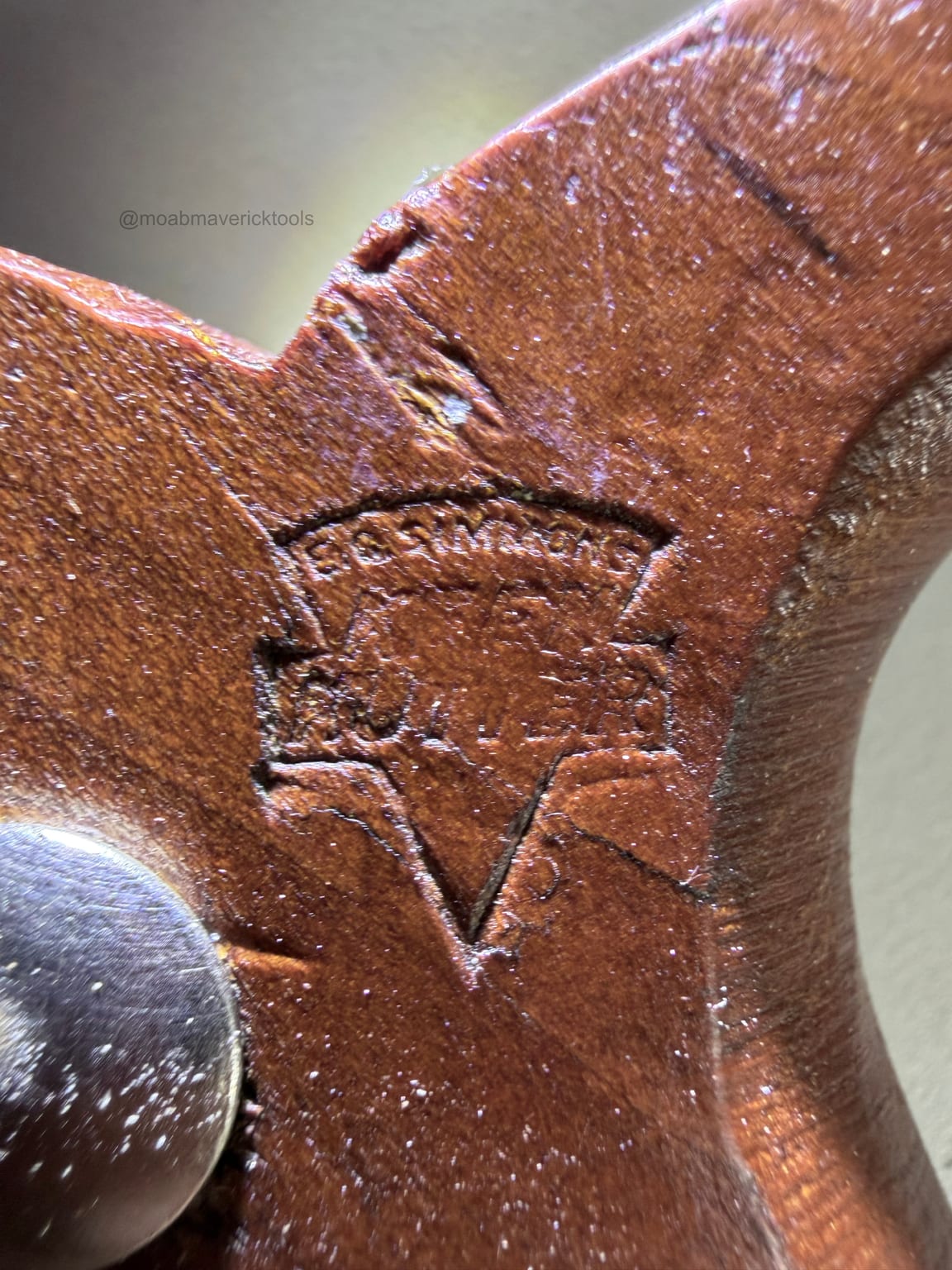
An Axe, a Pencil, and a Very Good Story
There is an odd echo between my own Keen Kutter story and the traditional story of how the brand began.
I bought an old Keen Kutter because I wanted a good hatchet and didn't particularly want to pay the price of a good new one. According to the traditional Keen Kutter origin story, Edward Campbell Simmons faced essentially the same problem in 1867.
His problem was the price of the popular Lippincott axe.
The familiar account says Simmons wanted an axe with an especially thin blade suited to soft timber. He fashioned a wooden model of his improved axe and, almost as an afterthought, penciled the words Keen Kutter onto the fresh wooden prototype. Later versions identify Isaiah Blood of Ballston, New York, as the manufacturer Simmons found to produce it.
It's exactly the kind of origin story a marketing department would invent.
And this is where we need to be careful. The story has been repeated extensively in Keen Kutter histories, including by the current trademark owner. But contrary to some modern attributions, I have not found the Lippincott/wooden-model story in Saunders Norvell's Forty Years of Hardware. Norvell certainly knew Simmons and writes extensively about Keen Kutter, but that doesn't make him the source of every story later associated with the brand.
There is, however, documentary evidence very close to the traditional date. A federal Keen Kutter trademark registration filed by Simmons in 1905 claims first use of the mark in 1868. The 1936 federal appellate decision likewise describes Simmons as having used the wedge-shaped Keen Kutter mark since 1868.
So we can separate two things. The wonderfully specific story about Simmons, an expensive axe, a wooden model, and a penciled name remains a traditional account whose earliest source still deserves investigation. The existence of Keen Kutter by 1868 has documentary support.
That's a less tidy answer than simply declaring the whole story true or false, but it's a better one.
A Trademark Becomes a Brand
By the time Norvell was traveling for Simmons, Keen Kutter had become something much larger than a mark on an axe.
His memoir provides a glimpse of just how thoroughly Simmons understood branding. When Norvell was a young salesman, the company gave customers small gold Keen Kutter axes as badges. Simmons personally instructed him not to let a customer see that he carried a dozen of them. Instead, Norvell was to wear one on his own lapel, remove it, and personally pin it on the customer's coat—making the little badge seem important rather than plentiful.
That's a remarkably modern lesson in brand psychology from a nineteenth-century hardware wholesaler.
Norvell also describes traveling with a trunk of samples containing Keen Kutter pocket knives and shears alongside other major cutlery brands. He recalls Keen Kutter goods being stocked even in small general stores.
And then there are those sheep shears.
Norvell says Mexican shearers working around southern Colorado and New Mexico often couldn't read the Keen Kutter name, but they recognized the image etched on the blade and refused substitutes without it. The brand had become recognizable even when the customer couldn't read the words.
The story gets better. George Tritch Hardware Company, a competing Denver jobber, eventually wanted twelve dozen Keen Kutter shears. Its buyer asked Norvell for a favorable price. Norvell theatrically covered a sheet of paper with calculations before quoting him the normal price. When the buyer complained, Norvell essentially told him that if he wanted Keen Kutter shears, he'd pay the Keen Kutter price.
He did.
That's probably more revealing about the strength of Keen Kutter at the time than any advertising slogan we could quote.
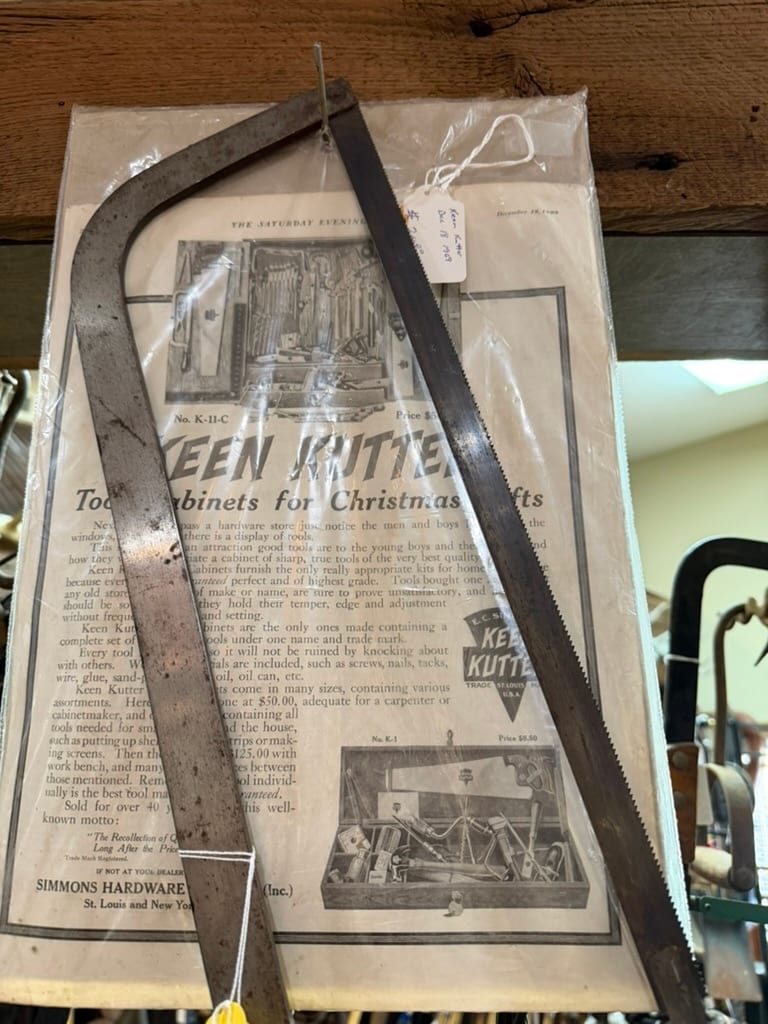
Simmons reinforced that recognition with enormous breadth. Period advertising and catalogs offered Keen Kutter tools across trades and, by the early twentieth century, even complete Keen Kutter tool cabinets. A December 1911 advertisement offered cabinets from $8.50 to $125 and described the trademark as a guarantee of quality.
The company's famous promise summed up the position it wanted Keen Kutter to occupy:
The Recollection of Quality Remains Long After the Price is Forgotten.
More Than a Name on a Tool
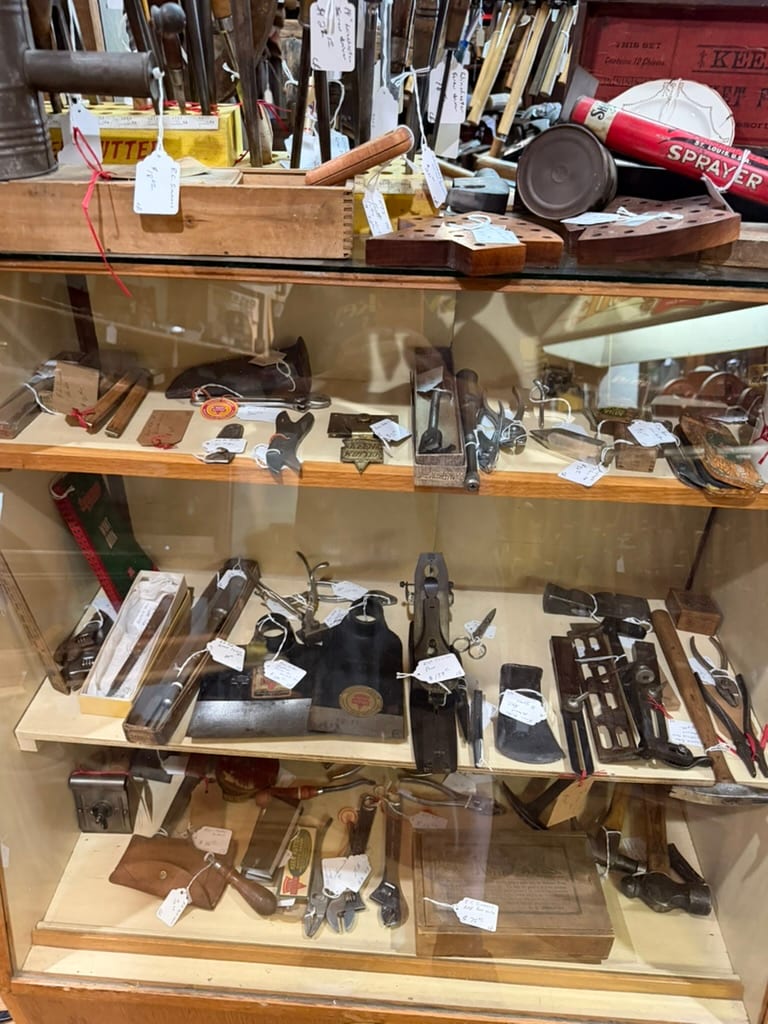
Much of the surviving dealer material photographed for this story comes from the collection of a Mid-Missouri antique dealer who specializes in Keen Kutter and Shapleigh material. His collection includes tools, packaging, advertising, gasoline cans, signs, and large glass-fronted store cabinets.
Walking through it makes something obvious that isn't nearly as apparent from a trademark record.
Keen Kutter wasn't just a label. It was a retail presence.
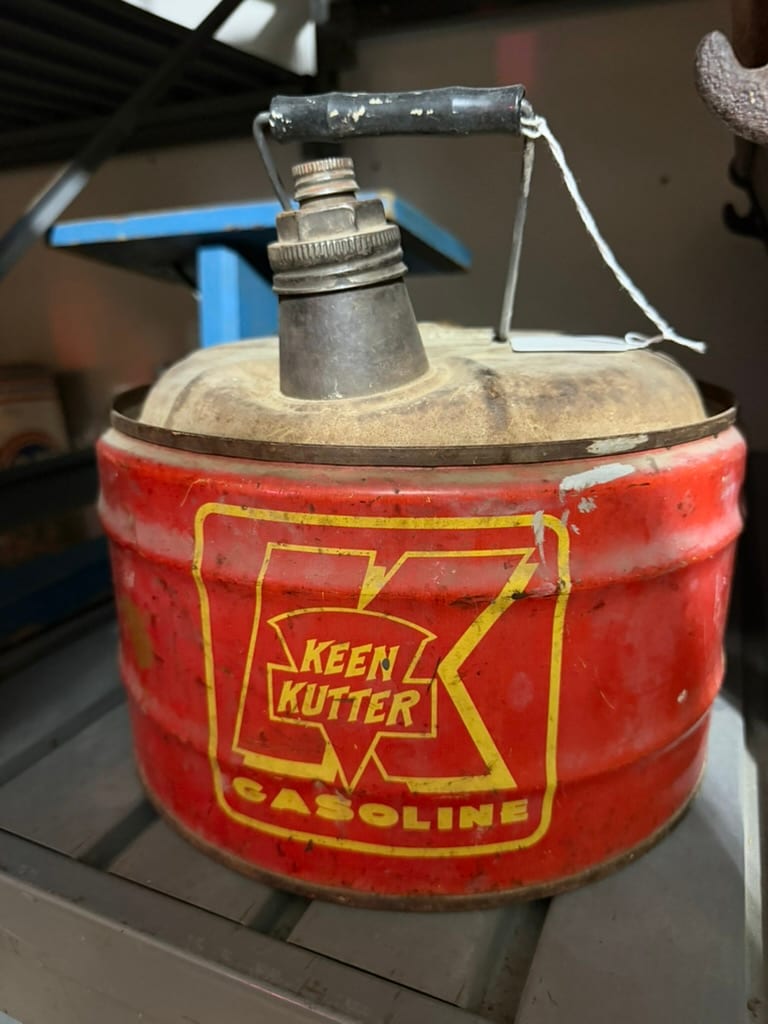
The surviving objects are remarkably varied. There are branded containers and tool boxes, advertisements, display pieces, store fixtures, and tools covering trades from woodworking to agriculture. The point isn't that every object was manufactured by Simmons. As Norvell's sheep-shear story demonstrates, the opposite could be true.
The consistency was the identity presented to the customer: Keen Kutter.
Becoming the Local Keen Kutter Dealer
That retail presence survives especially well in a remarkable group of dealer signs.
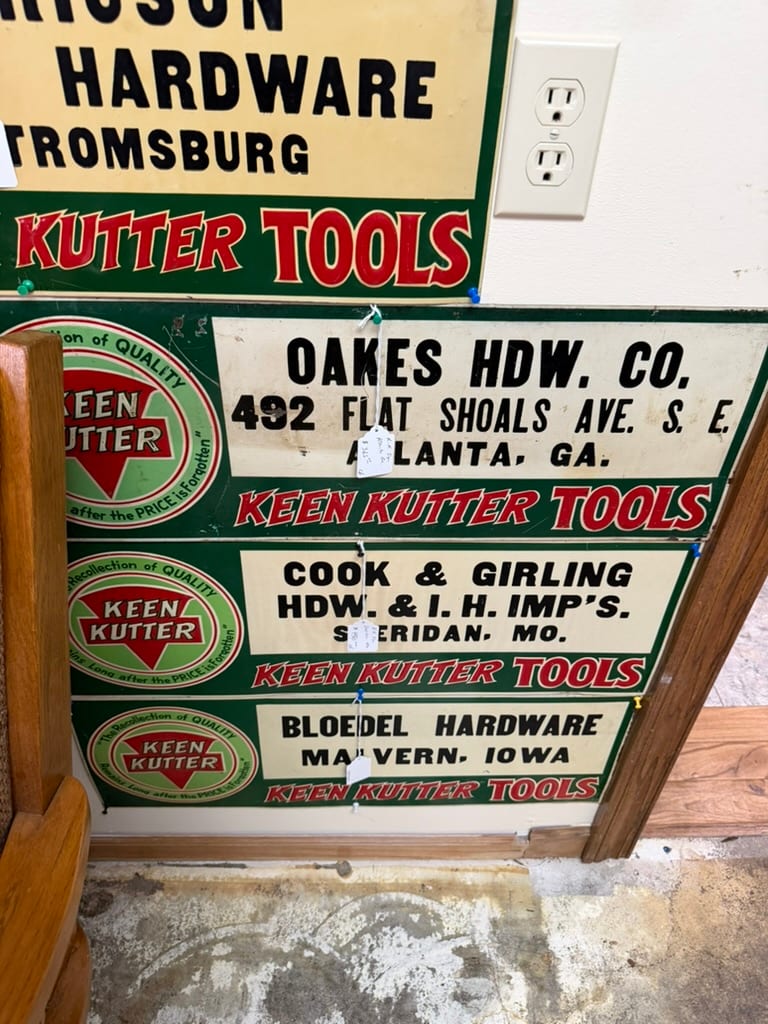
The format repeats over and over: Keen Kutter branding occupies one side of a green metal sign while a large white field identifies an individual hardware dealer. Examples photographed for this story identify stores in Missouri, Kansas, Iowa, Nebraska, Kentucky, Georgia, and elsewhere. The lettering used for the individual dealers varies substantially, while the underlying Keen Kutter design remains remarkably consistent.
The collector explained that Keen Kutter encouraged hardware merchants to identify themselves as Keen Kutter dealers, supplying participating stores with advertising and merchandising material that included signs such as these.
We have not yet located the original dealer agreement or circular describing the precise terms of that program, so his explanation remains knowledgeable oral history rather than documented corporate policy. But the physical evidence fits it well: standardized national branding combined with dealer-specific information, repeated across independent hardware stores in multiple states.
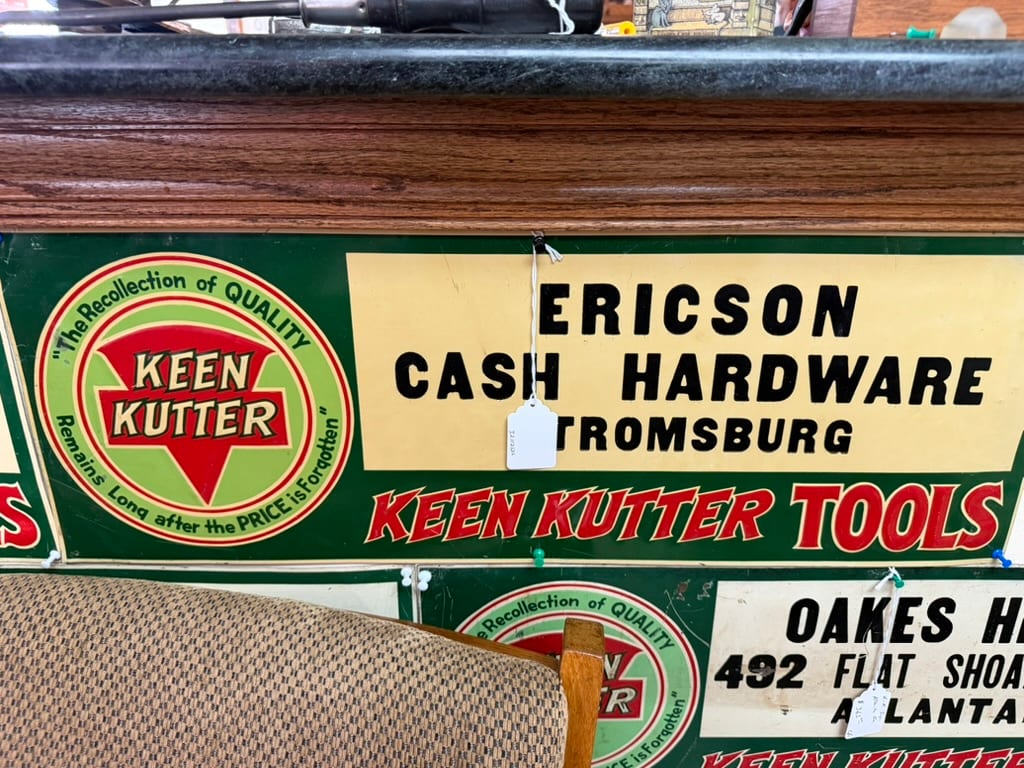
The scale of Simmons's sales organization makes such a program entirely plausible. Norvell describes a company intensely focused on selling, training its salesmen, building personal relationships with retailers, and turning those salesmen into almost evangelical advocates for the house. He remembered Simmons inviting forty or fifty salesmen at a time to his home and described the company's traveling force as absolutely convinced that no competing hardware house could approach Simmons.
The signs are surviving pieces of that retail world.
And among them are Diamond Edge dealer signs built around a strikingly similar concept. That matters because Diamond Edge belonged to another great St. Louis hardware house: Shapleigh.
When Competitors Become One Company
Simmons suffered serious financial trouble during the Depression, and in 1940 Shapleigh acquired its assets. Shapleigh now controlled both its own Diamond Edge trademark and its former competitor's Keen Kutter brand.
After the acquisition, the E.C. Simmons identification disappeared from later Keen Kutter branding. Some Shapleigh-era material explicitly associates Shapleigh with Keen Kutter, while other products use different Keen Kutter treatments. The useful dating point is therefore not that every post-1940 Keen Kutter tool carries one particular Shapleigh logo. It doesn't.
Rather, an E.C. Simmons Keen Kutter mark places a tool on the Simmons side of the ownership change. The Hardware Companies Kollectors Klub history of Shapleigh documents the acquisition and later Keen Kutter material.
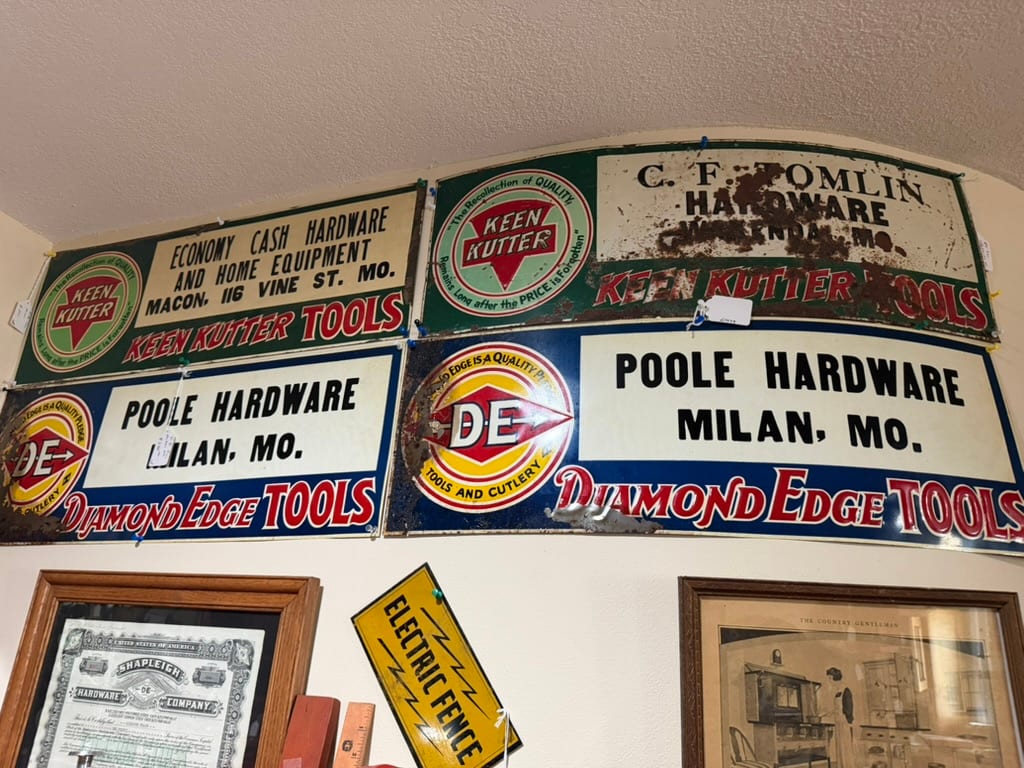
Shapleigh continued selling Keen Kutter after the acquisition. The trademark eventually passed through later ownership, and a major 1916 Keen Kutter registration is currently registered and renewed to Val-Test Distributors.
The brand outlived the company that created it.
What the Mark Can—and Cannot—Tell Us
Moab Maverick Tools has now handled several Keen Kutter tools, including the roofing hatchet that started this story and an E.C. Simmons dehorning saw.
That variety is part of what makes the brand interesting, but it also demonstrates why identification requires care.
The clear E.C. Simmons mark on the dehorning saw establishes an important fact: the saw belongs to the Simmons era. It doesn't establish precisely when within that era the saw was made, nor does the trademark alone tell us who manufactured every component.
Norvell's memoir gives us unusually good evidence that this isn't merely modern collector caution. He personally sold Keen Kutter goods and explicitly described products manufactured by other companies but branded for Simmons.
The same caution applies to catalog dates, logos, advertising designs, and collector terminology. Each is evidence; none deserves more certainty than it can actually support.
That's particularly important online, where one uncertain claim can be copied into twenty articles, auction descriptions, and marketplace listings.
Twenty repetitions do not create twenty independent sources.
Sometimes all twenty lead back to one old story. Sometimes the story is right, sometimes it's almost right, and sometimes the surviving evidence tells us that everyone has been repeating the wrong answer.
Fact, Legend, and the Space Between Them
Keen Kutter illustrates why researching antique tools can be both rewarding and frustrating. Some parts of its history are unusually well documented: catalogs, federal trademark registrations, court records, advertisements, surviving tools, packaging, dealer signs, and store fixtures.
We also have something unusually valuable in Forty Years of Hardware: the recollections of a man who actually worked inside Simmons and sold Keen Kutter goods. But even a firsthand source has boundaries. Norvell tells us things later writers can only reconstruct, yet his memoir doesn't automatically verify every story subsequently attributed to the company.
Other parts of the history reach us through collectors who have spent decades around the material. Still others survive as stories, like Simmons penciling Keen Kutter onto a wooden axe model in 1867.
It would be easy to choose between two bad approaches: repeat every colorful old story as fact, or discard everything that doesn't come with a dated invoice and archival reference number. Neither gets us very close to how history actually survives.
The better answer is to say what kind of evidence we have.
We can document Simmons's claimed use of Keen Kutter to 1868. We can document the extraordinary breadth and strength of the brand. Norvell gives us firsthand evidence that Keen Kutter goods could be manufactured by outside companies and sold under Simmons's special brand. Surviving advertising and dealer material demonstrate the retail identity Simmons built around it. The collector's description of the dealer program fits the surviving artifacts, although we have not yet found the corporate paperwork describing the arrangement.
And the wonderful story about the expensive Lippincott axe and the penciled wooden model?
For now, that's a story with some supporting context—not a documented event.
That's not a weakness.
That's the historical record as we presently understand it.
Back to One Old Hatchet
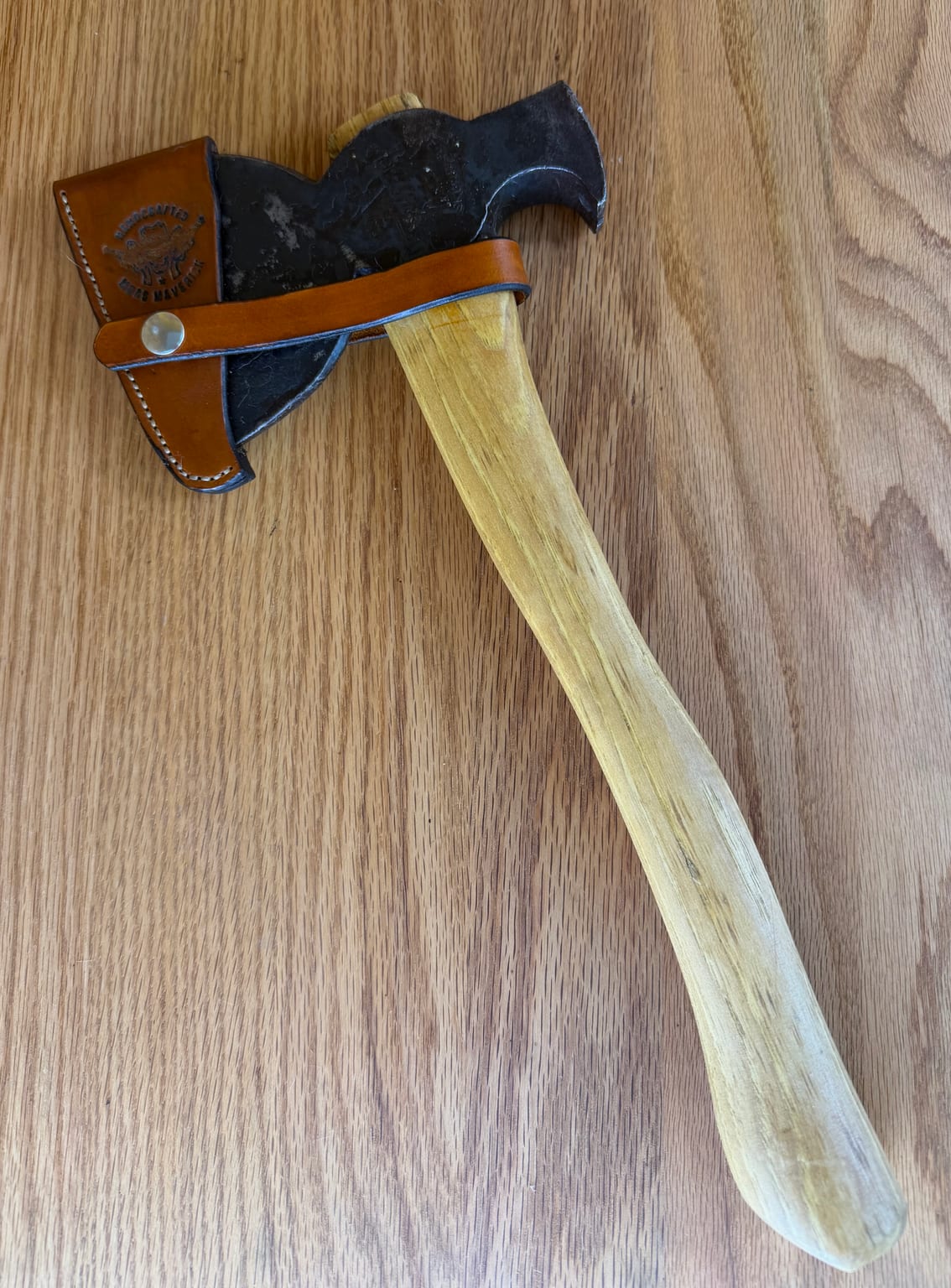
All of which brings us back to an old roofing hatchet.
When I bought it, none of this was a business plan. I wanted a good usable hatchet and didn't particularly want to pay what a good modern one cost. I liked the St. Louis connection, and an old Keen Kutter seemed considerably more interesting than buying another new tool.
Which, if the traditional Keen Kutter origin story contains even a kernel of truth, is a little amusing.
More than 150 years apart, Edward Campbell Simmons and I may have arrived at Keen Kutter for essentially the same reason:
We both thought a good new axe cost too damned much.
I cleaned mine carefully, fitted a new handle, sharpened the edge, made a sheath, and put it back to work. That project helped convince me that rescuing old tools could become something more than an occasional diversion.
Today, Moab Maverick Tools has restored and researched tools carrying dozens of American makers' marks. Some are famous. Some disappeared almost without documentation. Some require days of research simply to determine what they were designed to do.
But Keen Kutter remains different. It connects the place I lived for more than two decades, the history I now spend so much time researching, and the first restoration that suggested this might become something worth continuing.
The hatchet still lives in my truck. Its scars are still there.
So is the Keen Kutter mark.
Preserving the patina means preserving more than rust and finish. It also means preserving what we actually know about an object—and resisting the temptation to polish uncertainty into fact.