The Mark That Changed the Tool
A faint maker's mark led from a plausible identification as a nail puller to Frank W. Whitcher's 1887 patent—and to the tool's original place on a shoemaker's bench.
At first, the tool seemed to explain itself.
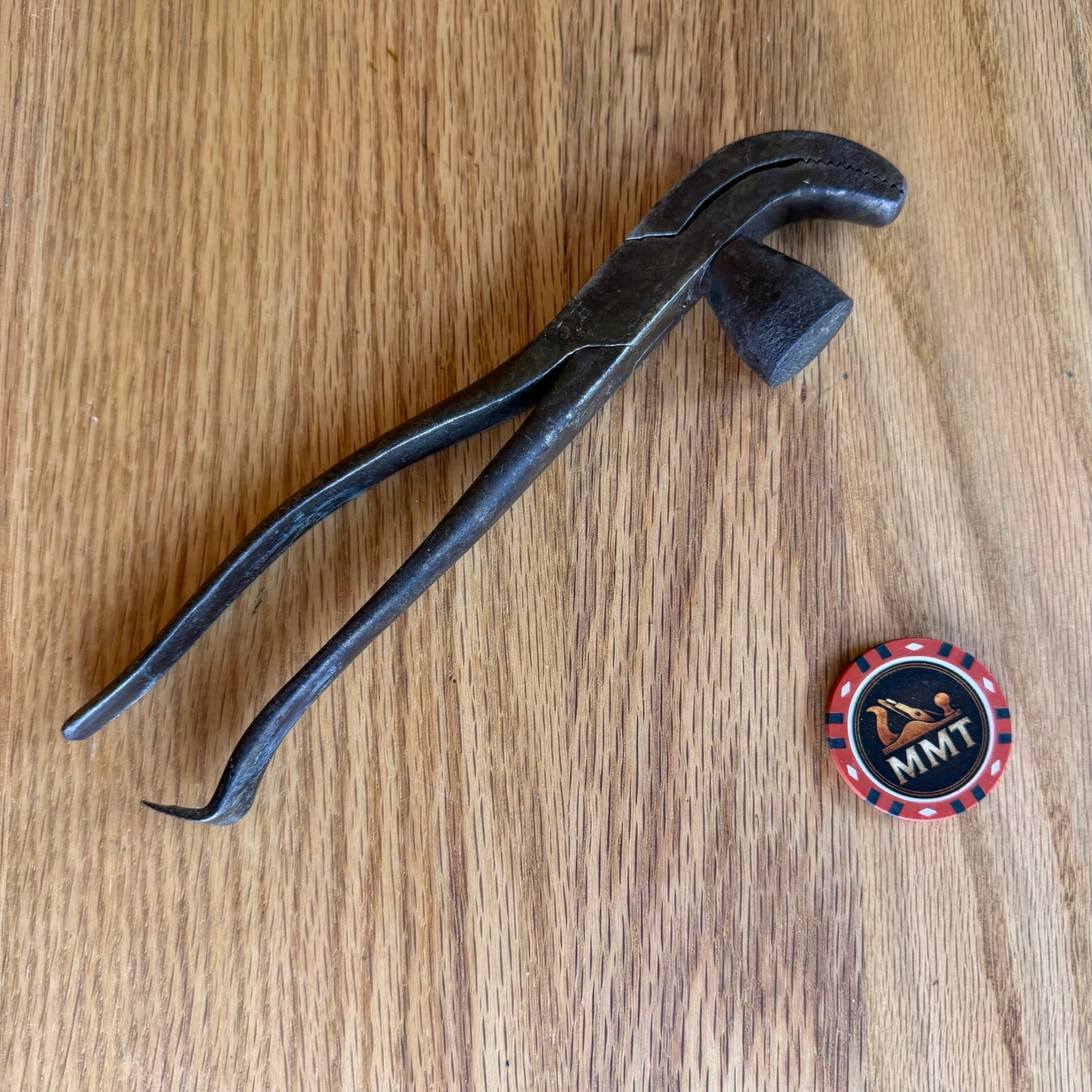
The antique-shop tag called it a nail puller. Its long handles, gripping jaws, a rounded projection near the head, and a small two-notch claw at the end of one handle made that identification seem plausible.
My first interpretation of the rounded projection was not that it was a hammer. I read it as a fulcrum: catch a nail head in the claw, bear the rounded projection against the work, and press down on the long handles for leverage. It was a coherent explanation of the form, and it reinforced the identification written on the tag.
But a plausible identification is still only a hypothesis. In this case, the evidence that overturned it was not the overall shape of the tool. It was a few shallow letters that became legible during a conservative cleaning.
Those letters led to a maker. The maker led to a patent. And the patent supplied the tool's original name and working context.
Sometimes identifying who made a tool tells you what the tool was made to do.
A Convincing First Impression
Before cleaning, the combination of serrated jaws, long handles, rounded projection, and notched claw suggested a purpose-built pulling tool. The claw could catch a small nail or tack, and the nearby projection looked as though it might provide a pivot point while pressure was applied to the handles. The curved jaws also appeared capable of gripping a nail shank or another stubborn object.
Nothing about that interpretation was unreasonable. It accounted for features that were actually present, and it agreed with the name under which the shop had sold the tool. It was also wrong about the tool's primary purpose—and about the function of that rounded projection, which proved to be an integral hammer.
That distinction matters in tool research. An identification based on appearance alone can remain convincing because it explains some of what an object can do. The better question is whether it explains the complete design, the maker's terminology, and the historical trade in which the tool belonged.
The initial “nail puller” identification explained the secondary claw. It did not explain the peculiar curved jaws nearly as well.
Cleaning for Evidence
The restoration was intentionally restrained. Loose oxidation and grime were removed with a brush, a light application of WD-40, and a 3M pad. The cleaned steel was treated with Ballistol and paste wax. Original pitting, wear, and patina were retained.
The goal around the markings was not to make the steel bright. It was to reveal as much information as possible without erasing the shallow evidence being sought.
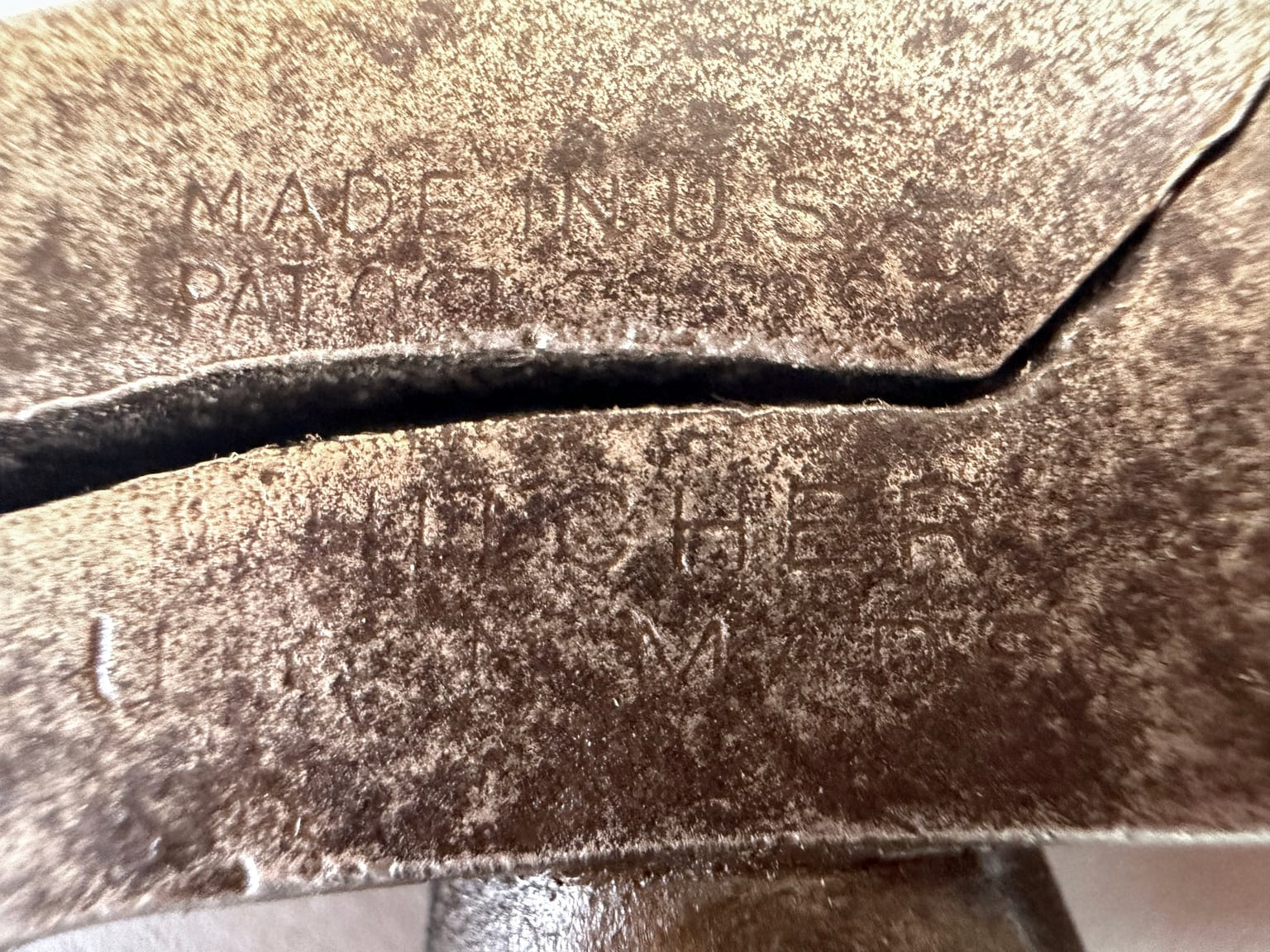
As the surface cleared, portions of several stamps emerged:
MADE IN U.S.A.- letters consistent with
WHITCHER - a probable
UNION MADE - a
3, consistent with a No. 3 size or model designation - part of a patent-date line, including
PAT., the upper portions ofOCT., and a surviving87
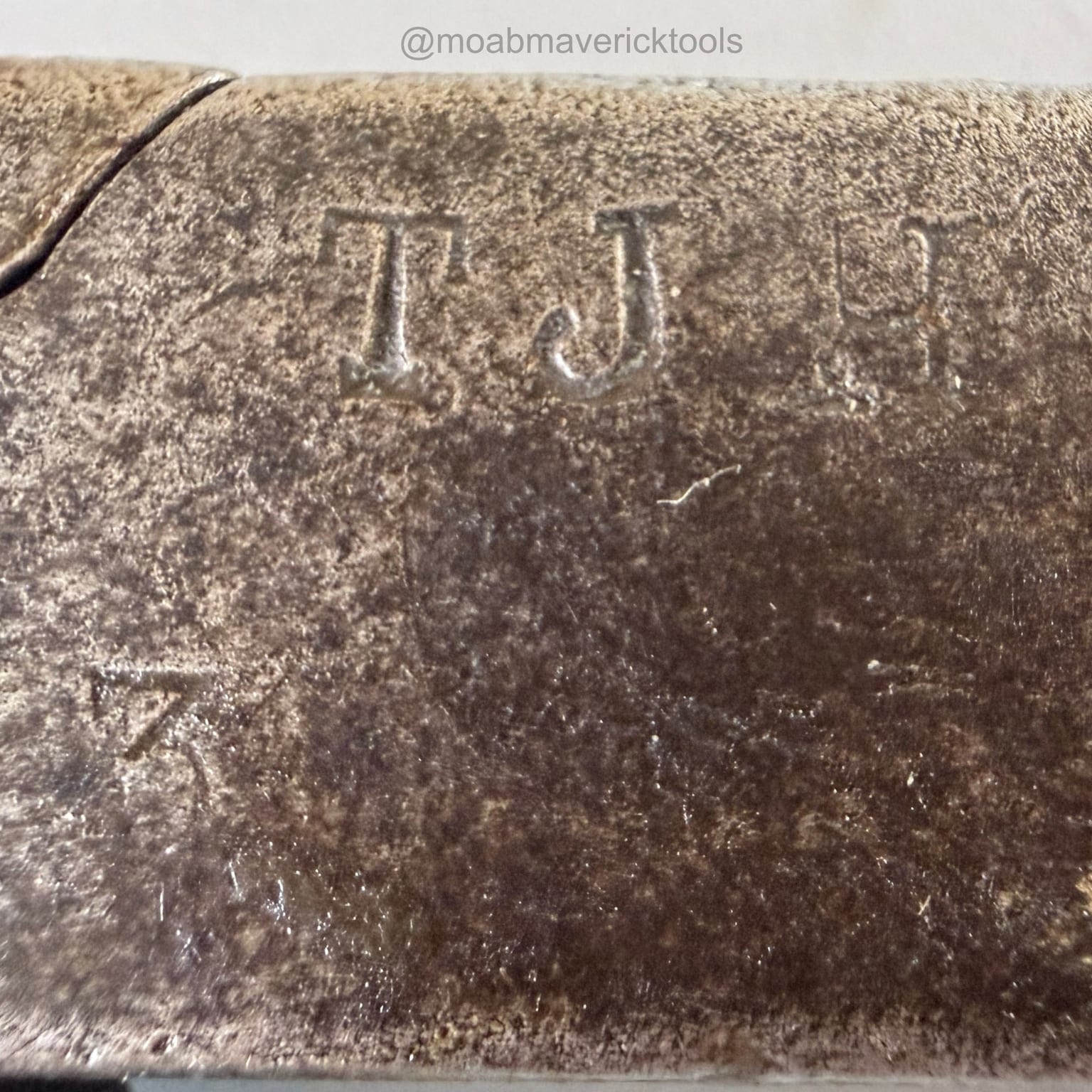
A deeper TJ stamp appears different from the faint factory markings and is best treated as a later ownership or user mark.
The maker's name did not become perfectly clear all at once. At one stage, only HITCHER could be read with confidence. The missing first letter mattered: searching the visible fragment as though it were a complete name produced noise rather than an identification. Once Frank W. Whitcher became a candidate, the faint leading W, the other markings, and the form of the tool could be tested against independent records.
At that point, photography became more useful than further abrasion. Low, raking light cast small shadows in the stamped grooves. Close photographs taken and adjusted for legibility made worn letters easier to compare while leaving the metal itself untouched.
This is an important part of preservation work: cleaning can expose evidence, but it can also destroy it. Once a mark is readable enough to investigate, documentation may have more value than another pass with an abrasive.
From Whitcher to the Patent
The partial WHITCHER mark opened a much narrower research path. Frank W. Whitcher of Boston patented an improvement to lasting pinchers on October 25, 1887. His patent was issued as U.S. Patent No. 372,246.
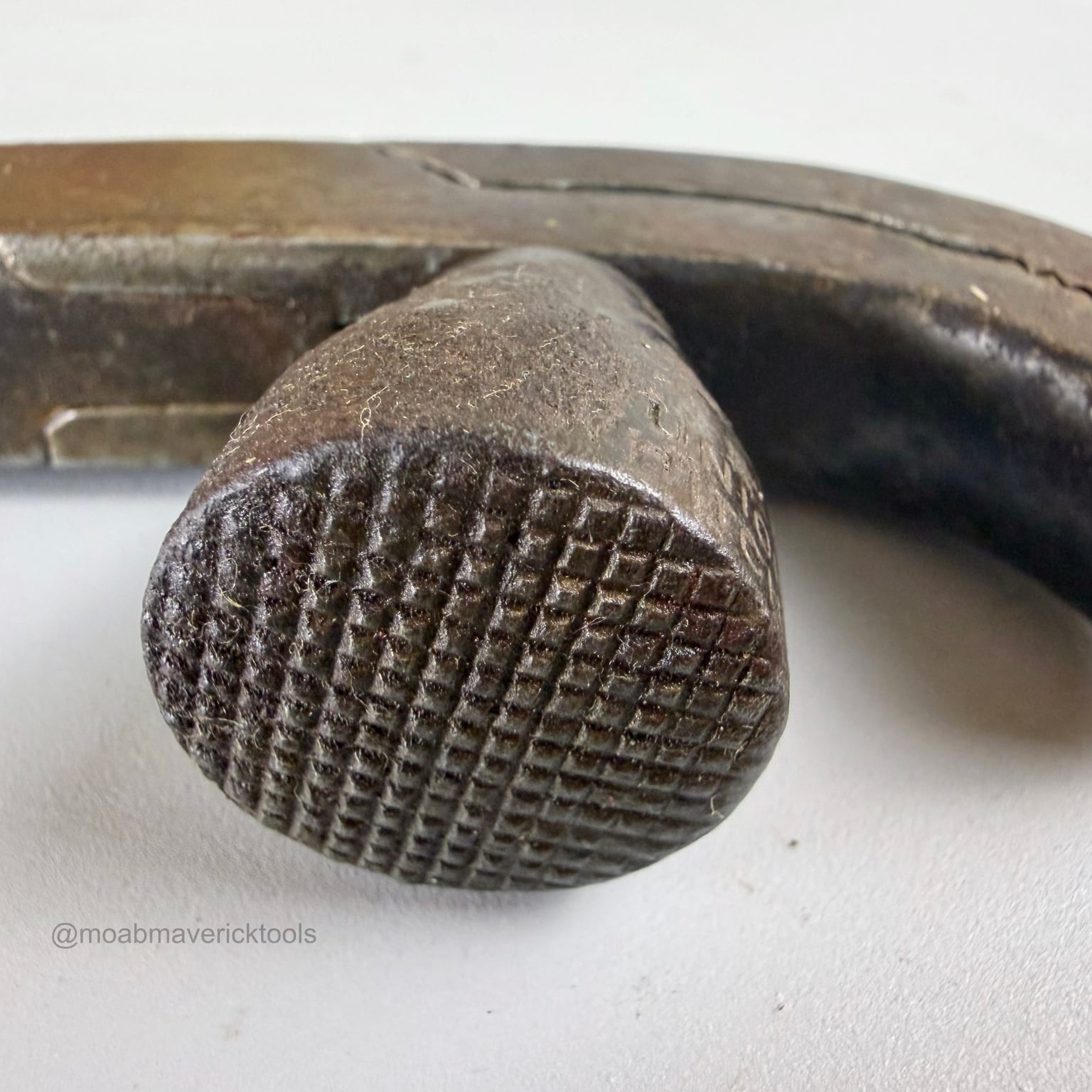
The patent did not merely supply a similar-looking drawing. It named the tool and described the construction of its hammer. Whitcher's improvement addressed a weakness in earlier lasting pinchers whose screw-mounted hammers could break near the shoulder when subjected to side blows. His design used a tapering or conical section of the hammer shank seated in a correspondingly flared socket, giving the hammer better support.
That detail is significant because the hammer and its mounting are among the most distinctive features of the surviving tool.
The documentary match extends beyond the patent. A 2009 article in The Tool Shed, published by CRAFTS of New Jersey, describes another pair of Whitcher lasting pliers carrying the same family of marks: UNION, the October 25, 1887 patent date, WHITCHER, and UNION MADE. The article also documents the Frank W. Whitcher Company and its association with union-marked tools. A separate surviving example has been recorded with UNION WHITCHER and a nearly identical combination of patent, union, and size markings.
Together, these records turn a partial name into a substantial identification:
Frank W. Whitcher “Union” No. 3 lasting pinchers, made for shoemaking or cobbling and based on the design patented October 25, 1887.
What Lasting Pliers Were Made to Do
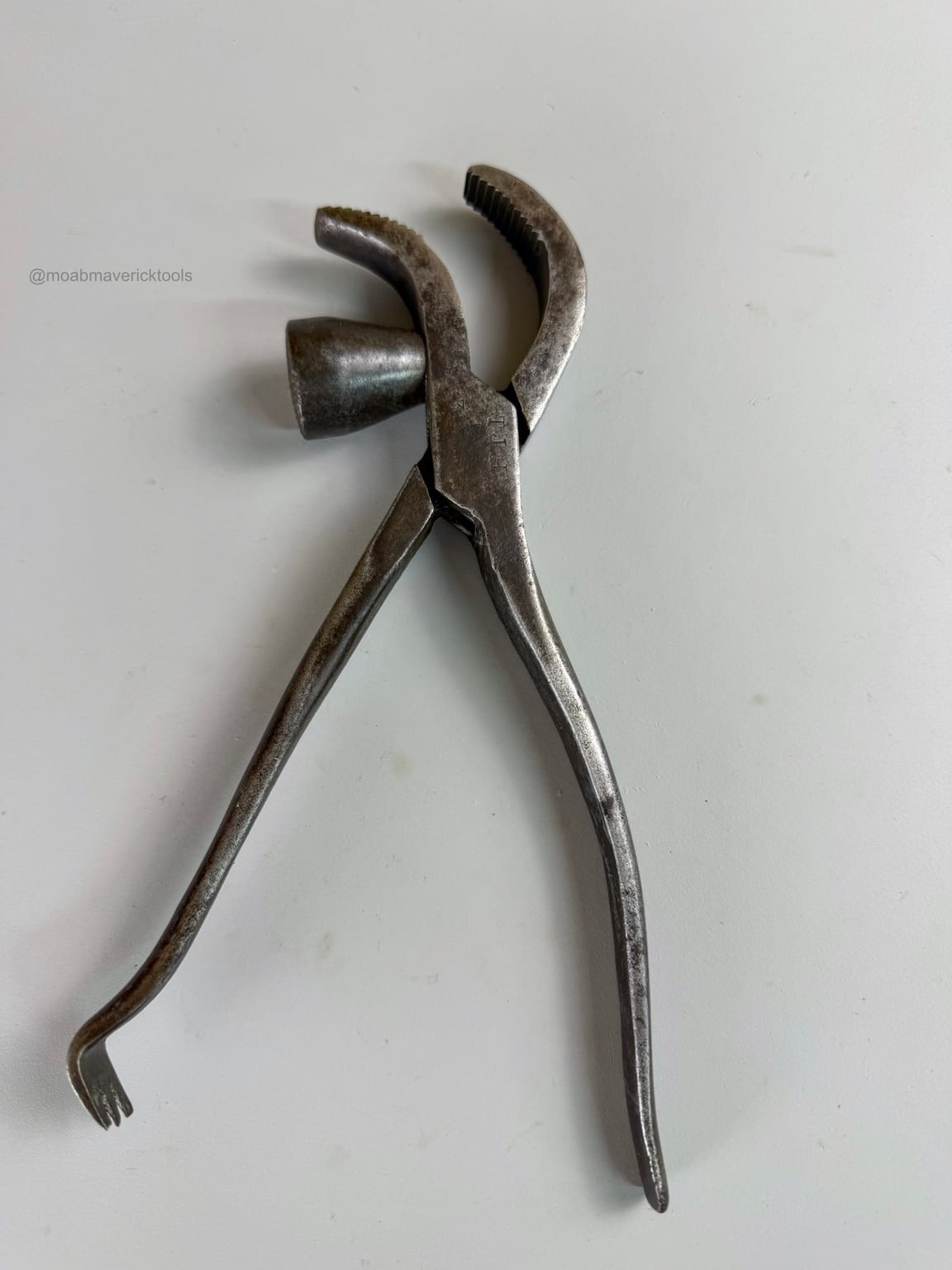
Lasting is the stage of shoemaking in which the upper is pulled over a foot-shaped last and secured in position. The curved, serrated jaws of lasting pliers grip the leather so the shoemaker can pull it tight. The broad outer surface of the jaw can help bear against the work as the leather is tensioned.
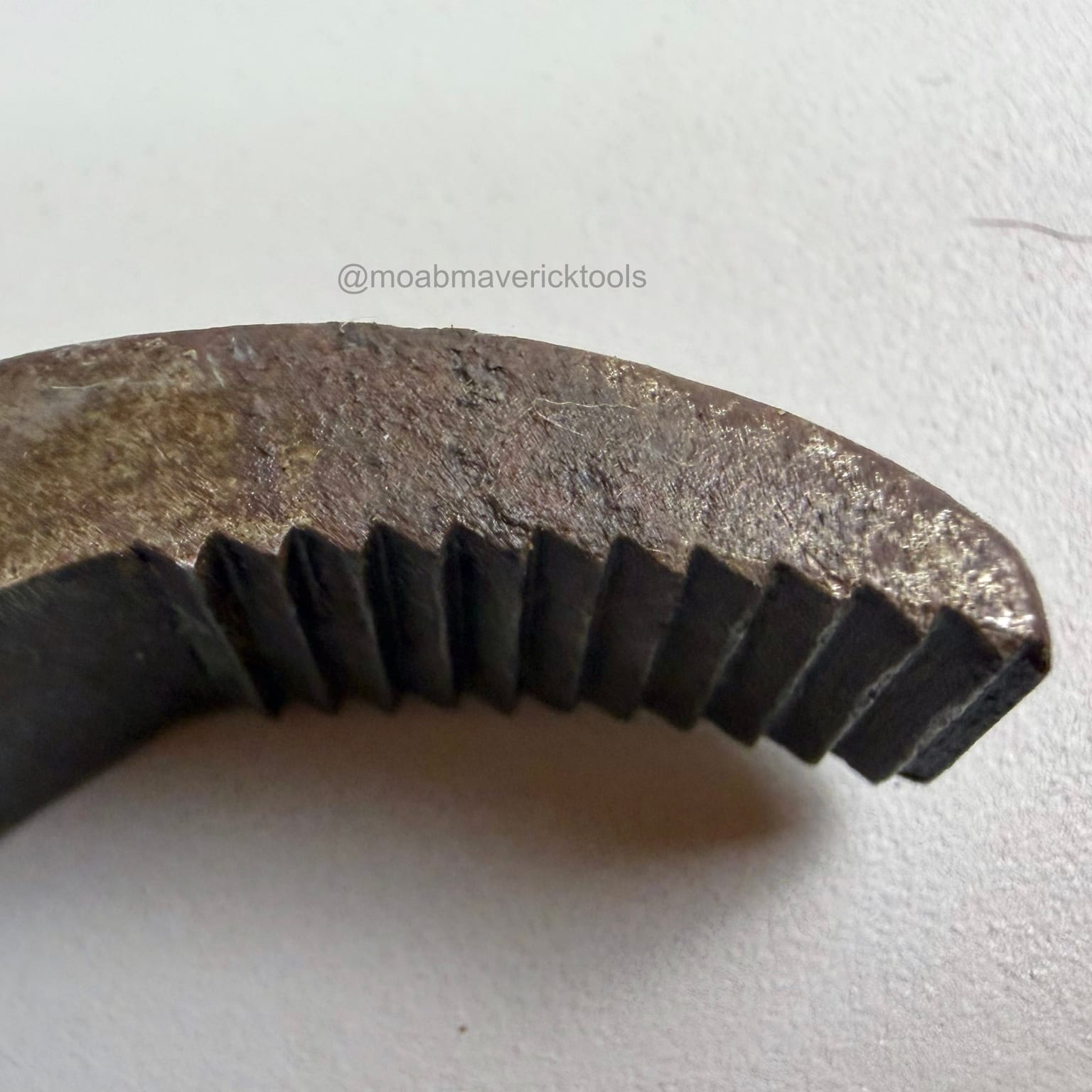
The integral hammer lets the worker set lasting tacks without putting down the pliers.
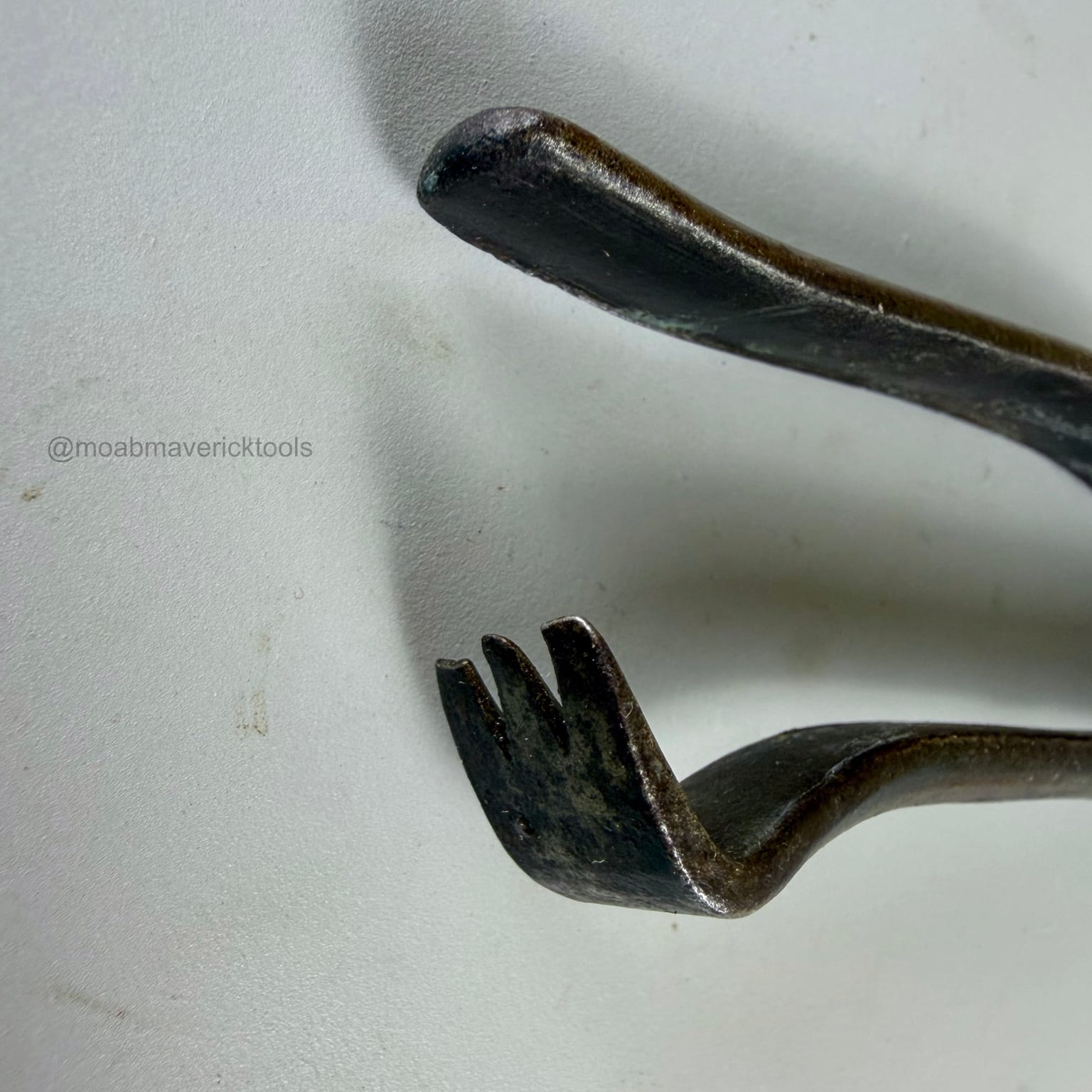
On this production tool, the two V-notches at the end of one handle form a three-tooth claw for pulling tacks. One outside tooth has an old chipped tip, but both V-shaped notches survive substantially intact.
Seen in that context, the tool's unusual collection of features is no longer miscellaneous. The jaws, hammer, and claw support a sequence of closely related operations at the shoemaker's bench: grip, pull, tack, and correct.
The nail-pulling ability was real. It was simply not the tool's primary identity.
Comparing the Patent to the Object
The surviving pliers align closely with the patent in their curved serrated jaws, pivot arrangement, and projecting hammer. That agreement is strong corroboration, but the two are not identical.
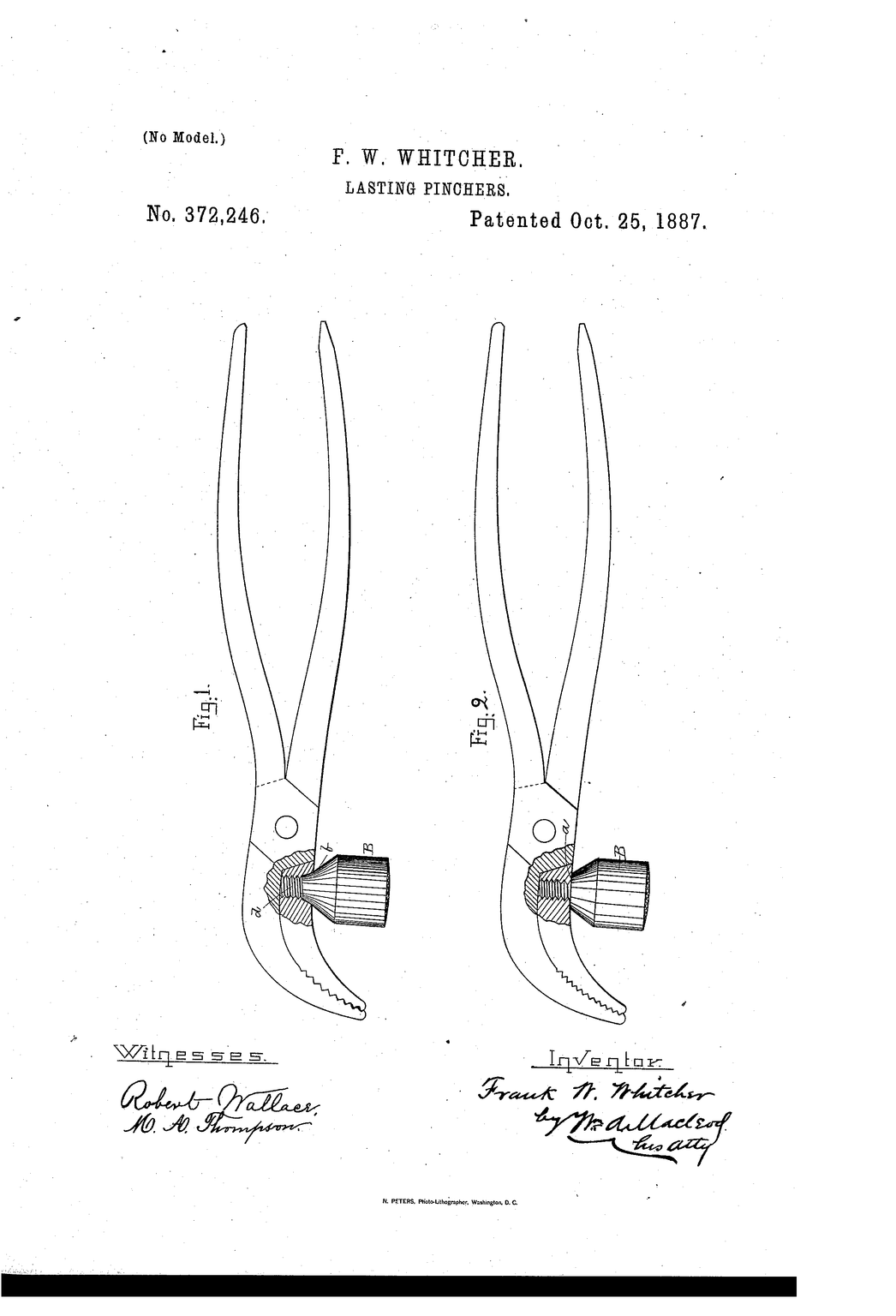
Most visibly, the patent drawing does not show the two-notch claw at the end of the handle. The surviving tool does.
It would be easy to claim that the claw was added after the patent application, but the available evidence does not establish that sequence. The patent is narrowly concerned with the hammer's attachment, and a patent drawing need not document every feature of every production version. The claw may represent a later addition, a production variant, or simply a feature outside the scope of the claimed improvement.
For now, the difference should remain a documented difference.
That is a useful discipline in object research. A strong identification does not require every discrepancy to be explained away. It requires the agreements and differences to be stated clearly, with confidence proportional to the evidence.
What the Patent Date Does—and Does Not—Tell Us
The patent establishes that Whitcher's improved hammer mounting was documented by 1887. Surviving fragments of the patent-date stamp on this tool agree with the October 25, 1887 record.
The date does not prove that this particular pair of pliers was manufactured in 1887.
Whitcher tools of this pattern remained in circulation after the patent was issued, and the current marking evidence does not support assigning this example to a precise year. “Patented October 25, 1887” is documented. “Made in 1887” is not. A turn-of-the-twentieth-century or early-twentieth-century manufacture is plausible, but the exact production date remains unresolved.
This distinction is especially important when a patent date is stamped prominently on an antique object. Patent dates are excellent research keys. They are not automatically manufacturing dates.
The Result
The restoration did not make the pliers look new. It made their evidence legible.
A partial maker's mark supplied the key that visual resemblance alone could not. WHITCHER led to Patent No. 372,246; the patent identified lasting pinchers; the physical form and surviving patent-date fragments corroborated the match; and research into comparable Whitcher tools connected the remaining marks.
The investigation can be summarized in four steps:
partial maker mark → maker identification → patent → intended use
What began as a credible nail puller became a specialized shoemaker's tool with a documented inventor, an 1887 patent, and a recognizable place in a working trade.
The correction is the story. It shows why maker marks are more than branding, why restrained cleaning can be an act of research, and why the most convincing identification is not the first one that fits the silhouette. It is the one that survives comparison among the object, its markings, the documentary record, and the details that do not quite match.
What We Can Say with Confidence
The evidence supports identifying the tool as Frank W. Whitcher “Union” lasting pinchers for shoemaking or cobbling, with an integral hammer and tack-pulling claw. The surviving 3 and comparable marked examples strongly support a No. 3 designation.
U.S. Patent No. 372,246 documents Whitcher's lasting-pincer design and its October 25, 1887 patent date. The maker, patent, and intended use are identified with high confidence. The precise manufacture date remains unknown, and the No. 3 interpretation is strong but not as firmly documented as the maker and patent.
One outside tooth of the three-tooth tack-pulling claw has an old chipped tip. Both V-shaped pulling notches remain substantially intact.